Metallized Polypropylene Film: Why Is This Thin Dielectric the Soul of the Performance of Self-Healing Shunt Capacitors?
In the pursuit of efficiency and reliability in the electrical industry, a seemingly minor material innovation can often trigger a qualitative leap in product performance, and metallized polypropylene film plays such a crucial role. How does this ultra-thin dielectric, measured in micrometers, become the soul of the performance of modern self-healing shunt capacitors? The answer lies in the deep integration of its material properties and electrical performance.

The Dual Mission of Insulating Medium and Energy Carrier
The most basic function of self-healing shunt capacitors is to store and release electrical energy. The core performance indicators of a self-healing shunt capacitor, such as capacitance stability, loss tangent, and lifespan, fundamentally depend on the quality of the dielectric material. Metallized polypropylene film perfectly meets this dual requirement. On one hand, it possesses extremely high dielectric strength, enabling it to withstand strong electric fields without breakdown, thus ensuring the capacitor's voltage margin. On the other hand, the extremely low dielectric loss characteristics of polypropylene material itself result in minimal energy loss during the storage and release of electrical energy, directly determining the capacitor's low heat generation and high efficiency during operation. This dual advantage makes metallized polypropylene films the ideal dielectric materials for self-healing shunt capacitors.
The Vitality Endowed by Self-Healing Performance
If the excellent insulation and low loss of metallized polypropylene film are the cornerstone of the static performance of self-healing shunt capacitors, then the "self-healing" capability of the metallized polypropylene film is the soul that gives self-healing shunt capacitors their dynamic vitality. The ultra-thin metal layer vacuum-deposited on the surface of the metallized polypropylene film is the key to realizing this magical "self-healing" function. When there are localized micro-defects in the dielectric or when breakdown occurs due to instantaneous overvoltage, the instantaneous high-temperature arc generated at the breakdown point causes the surrounding metal coating to rapidly evaporate and vaporize, thus forming an insulating isolation zone that automatically repairs the insulation defect, allowing the self-healing shunt capacitors to return to normal operation. This process is completely spontaneous and is completed almost within microseconds, ensuring that the self-healing shunt capacitors no longer fail entirely due to minor flaws, and their reliability and service life are revolutionarily extended. This seemingly fragile metal coating is actually an intelligent repair system that protects the long-term stable operation of the self-healing shunt capacitors.
Performance Amplification through Structure and Process
Even high-quality materials require precise craftsmanship and structural design to fully realize their potential. The edge thickening technology for metallized polypropylene films is an innovative process in this field, which enables polypropylene to truly demonstrate its advantages. The edge thickening significantly enhances the toughness of the electrode edges, allowing self-healing shunt capacitors to withstand higher impact currents and improving their shock resistance in complex grid environments. Simultaneously, advanced winding and heat treatment processes make sure that the metallized polypropylene film layers are tightly and uniformly packed, further reducing the risk of partial discharge, resulting in lower temperature rise and slower capacity decay in the self-healing shunt capacitors over long-term operation. The inherent advantages of metallized polypropylene films can only be translated into stable and reliable product performance through refined manufacturing processes.
Geyue Electric’s Manufacturing and Product Commitment
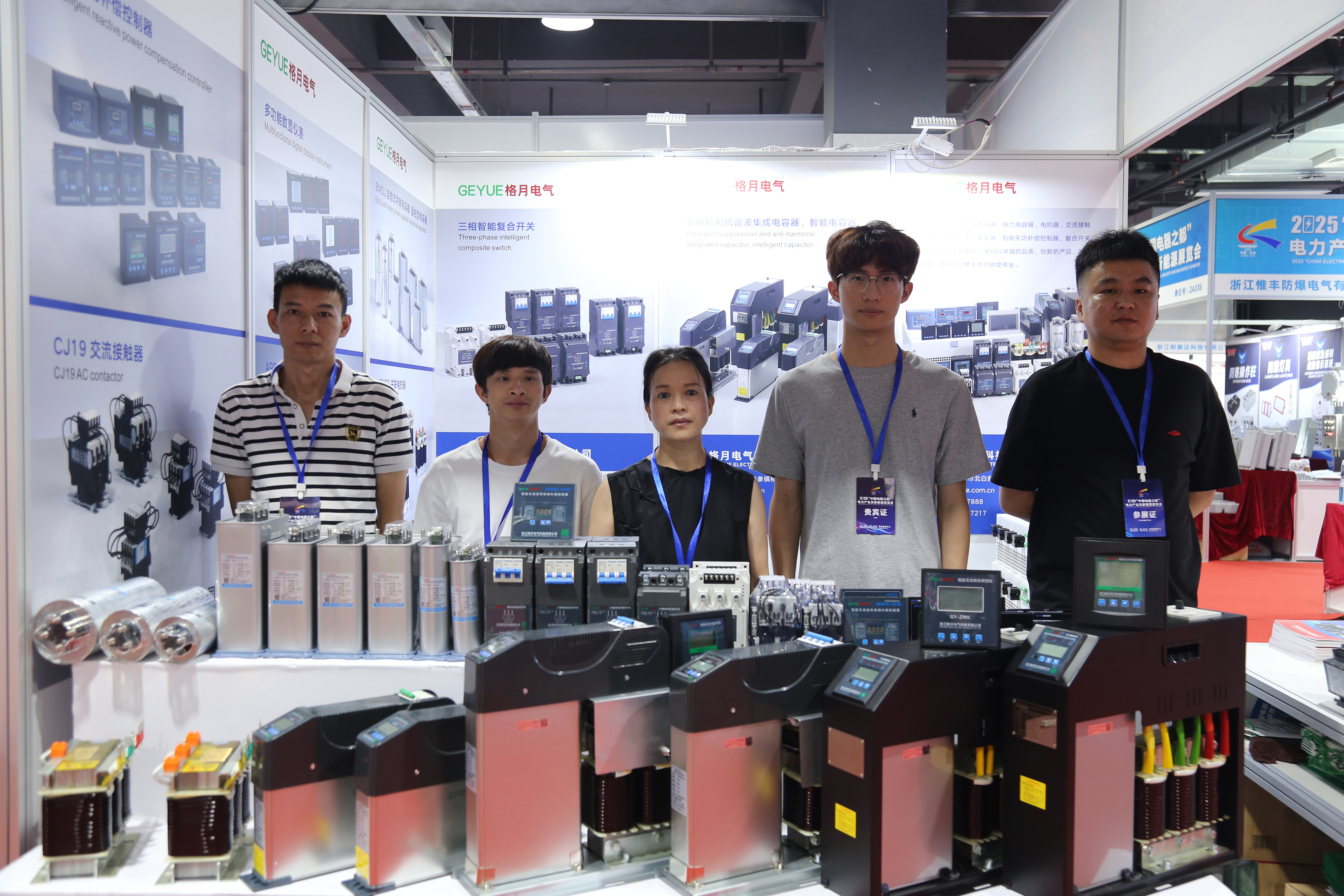
A profound understanding of materials is only the foundation for everything else; the real test of a manufacturer's comprehensive strength rests with how to transform those materials into durable and reliable products. Geyue Electric consistently regards the deep integration of materials science and manufacturing processes as the core value and ultimate goal of product development. We select high-quality metallized polypropylene film raw materials from leading global suppliers and have established a fully automated production line at our production base in Yueqing, Wenzhou, for precision winding, vacuum impregnation, and aging testing. This ensures that the superior performance of each film layer is 100% perfectly reflected in the final product.
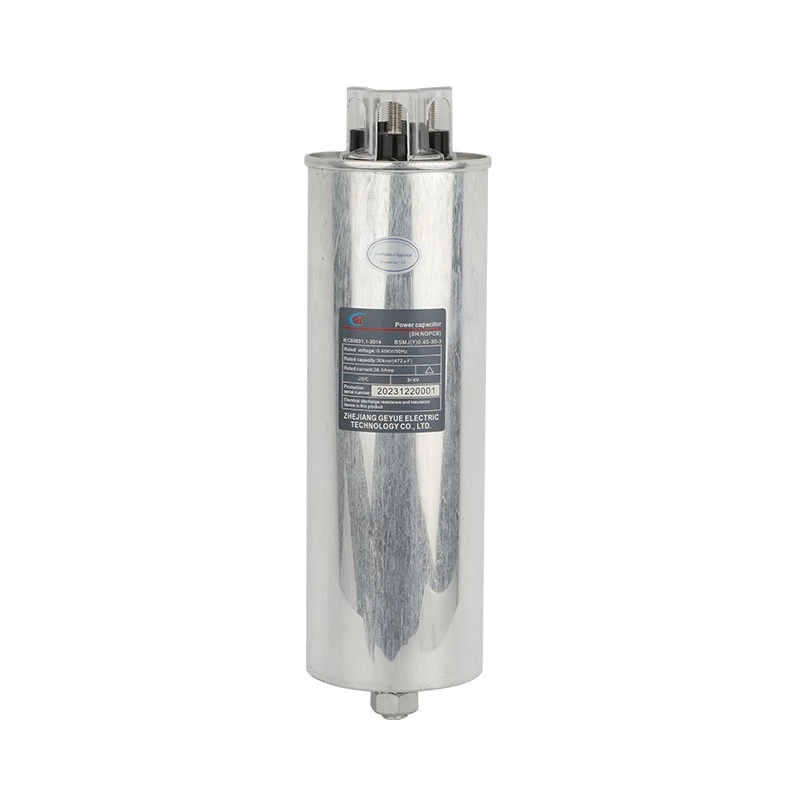
Based on our mastery of the core medium and stringent process control, we highly recommend Geyue Electric's BSMJ square box type self-healing shunt capacitors and BSMJ(Y) series cylindrical type self-healing shunt capacitors. The BSMJ series features a sturdy printed iron casing that has undergone special anti-corrosion treatment. It has a compact structure and is easy to install. The BSMJ(Y) series employs a high-performance aluminum casing with excellent heat dissipation performance and an elegant appearance. Both series are infused with high-performance microcrystalline wax as an environmentally friendly impregnating agent, completely eliminating the risk of oil leakage and achieving the dual advantages of cleanliness and safety in dry-type structures and stable reliability in impregnated capacitors.
If you are considering purchasing self-healing shunt capacitors to improve the power factor of your power system, please don't hesitate to send your inquiry to info@gyele.com.cn. Let us use this metallized polypropylene film, this "ultra-thin soul," to inject efficient, stable, and lasting vitality into your electrical system, and together build a more energy-efficient and reliable future for electricity.
Related News
- What Is the Difference Between a Power Capacitor and an Intelligent Capacitor?
- Are Self-Healing Shunt Capacitors Suitable for Industrial Applications?
- Why Does a Factory Need an Automatic Power Factor Controller?
- Can a Power Capacitor Reduce Electricity Losses in a Factory?
- What Should Engineers Check Before Choosing a Low Voltage Power Capacitor?
- Why Are Self-Healing Shunt Capacitors Widely Used in Low-Voltage Power Systems?
Leave me a message