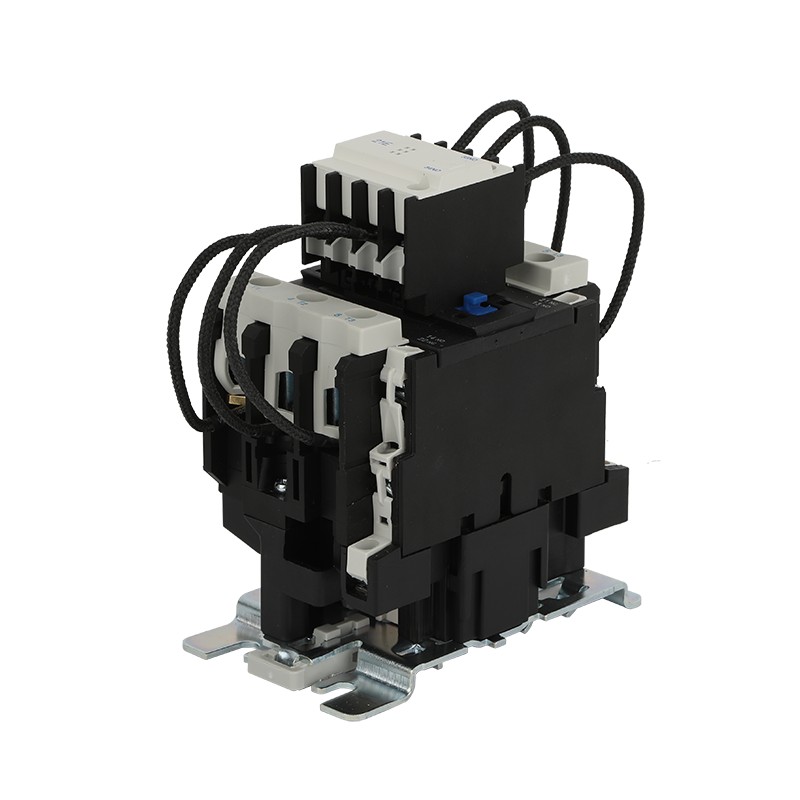
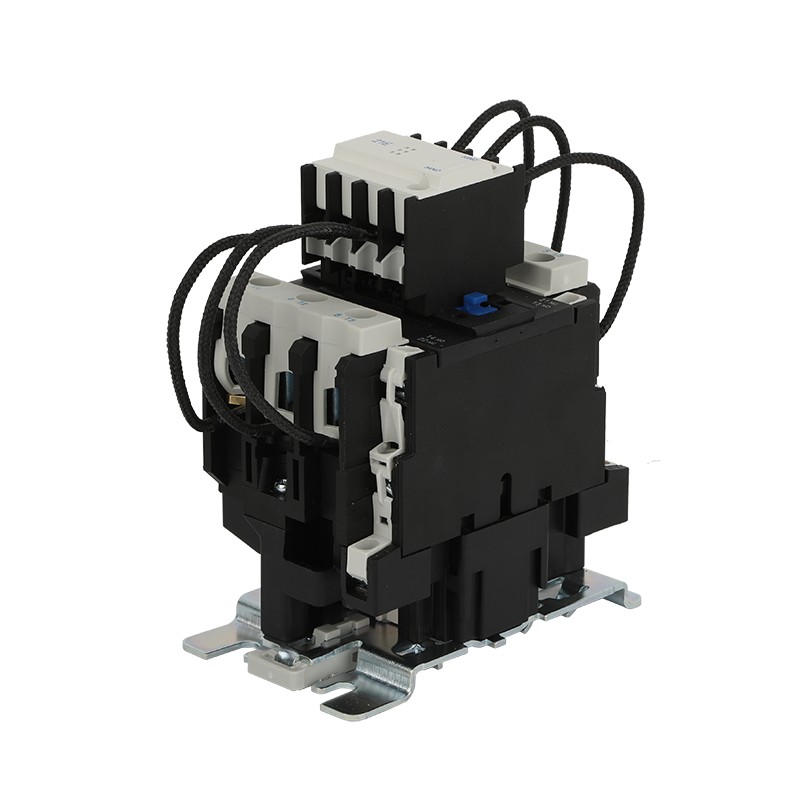
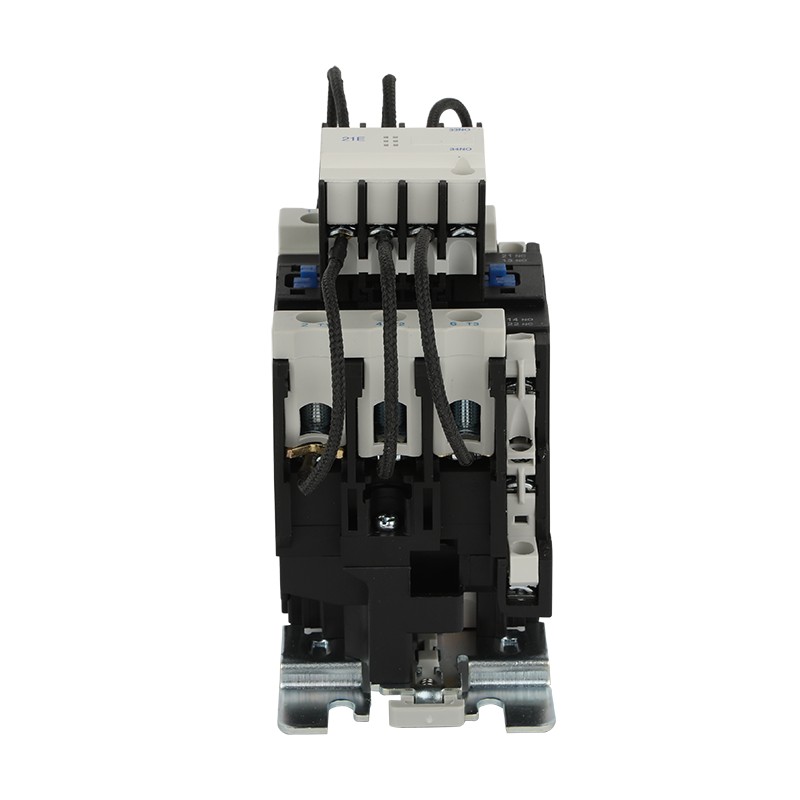
CJ19 Series Capacitor Switching Contactors
Model:CJ19 Series
Place of Origin: Wenzhou, China
Brand: Geyue
Model: CJ19 Series
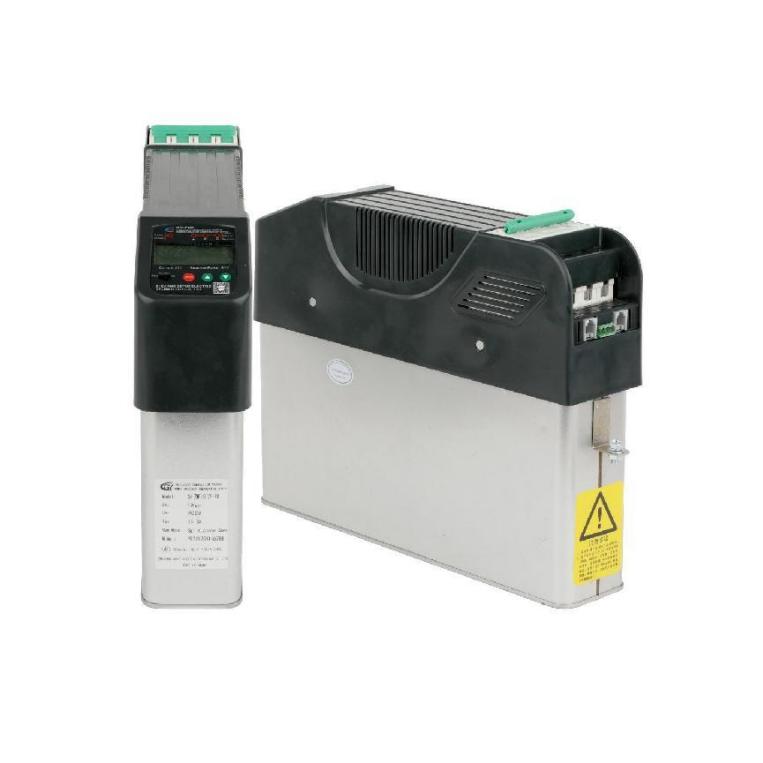
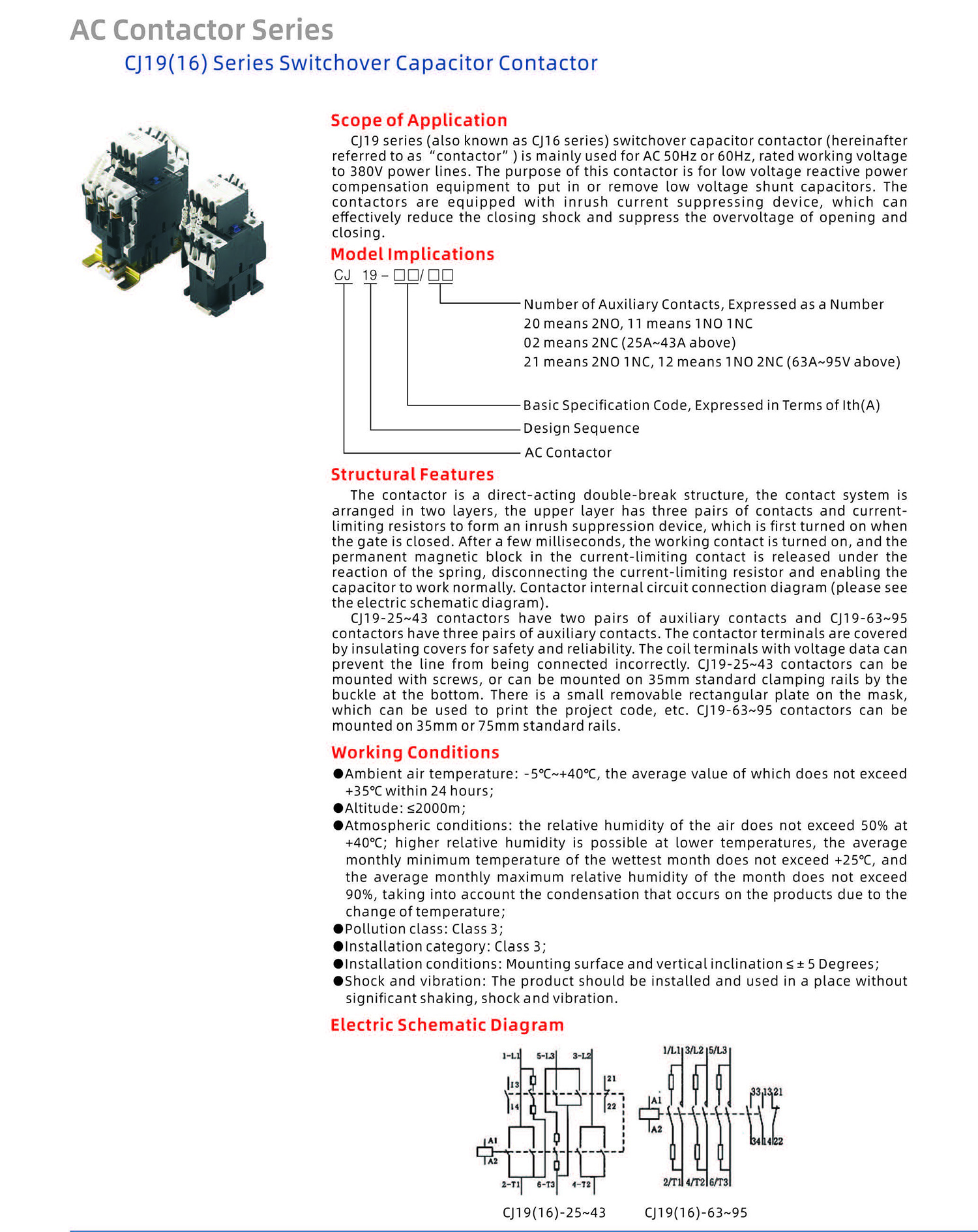
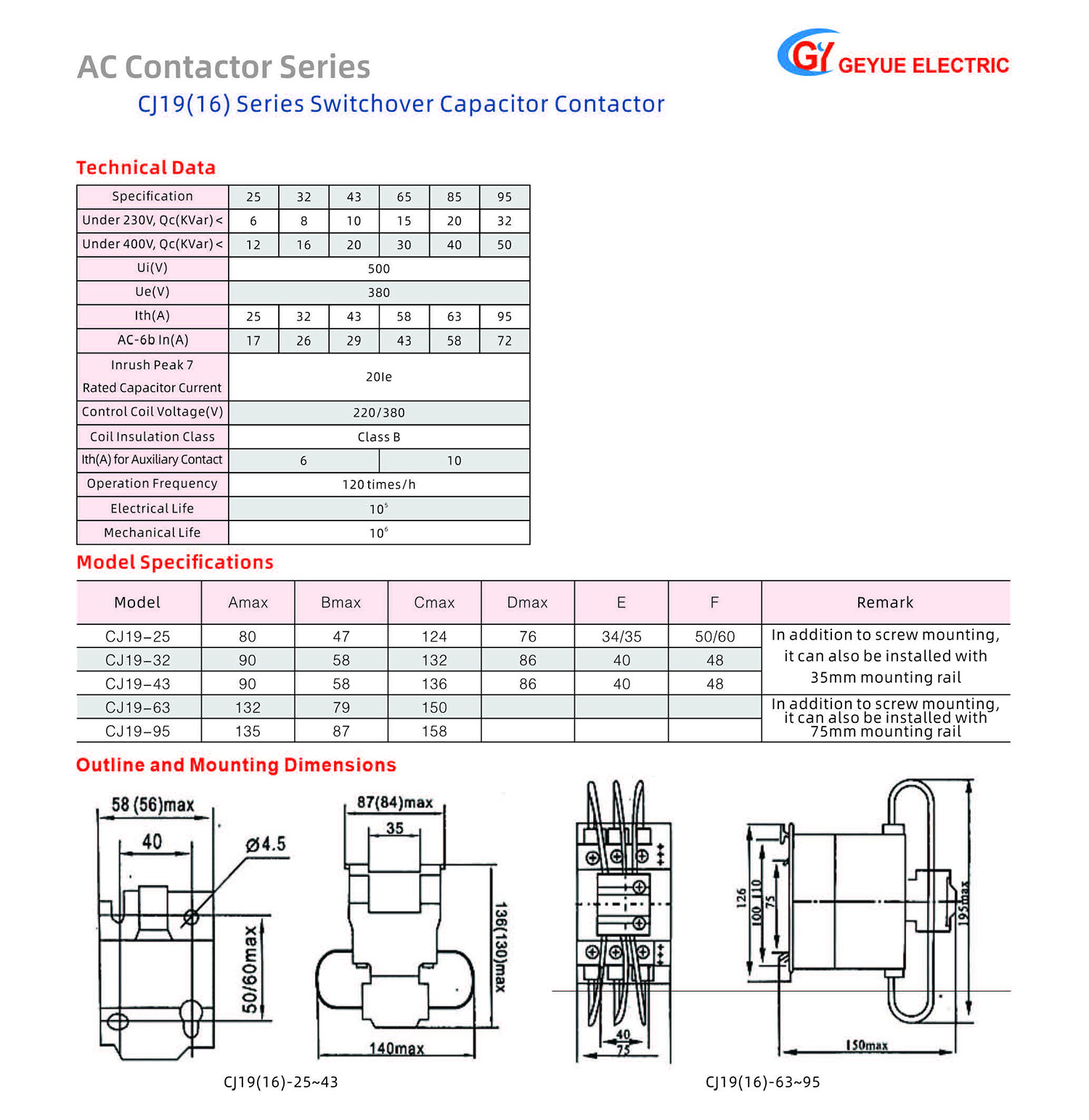
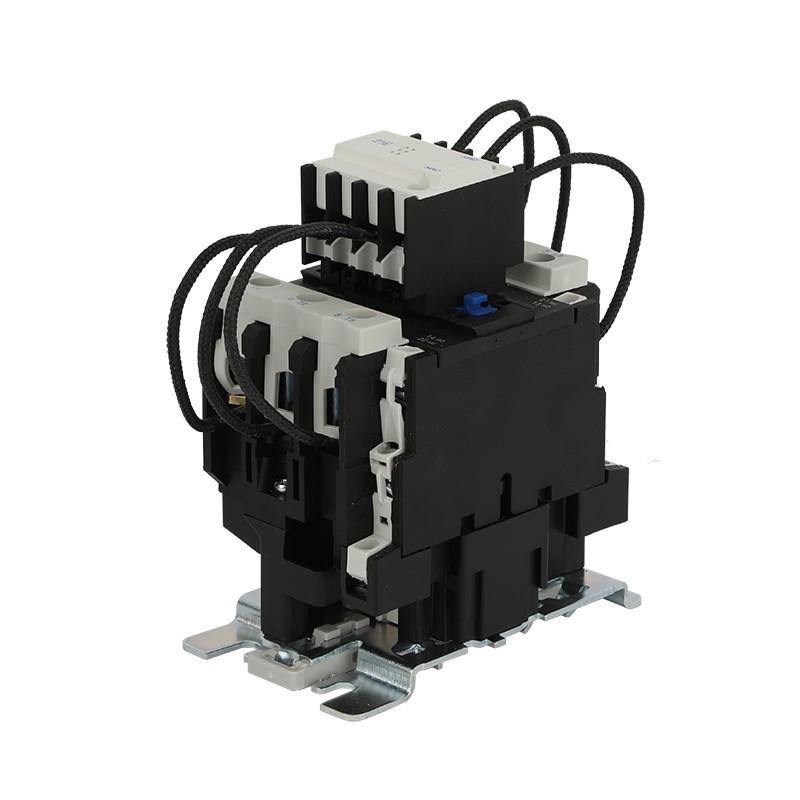
The CJ19 Series Capacitor Switching Contactor is a high-performance switchgear specially designed by Geyue Electric for low-voltage reactive power compensation systems. It adopts advanced magnetic retention structure and vacuum arc extinguishing technology, effectively solving industry problems such as inrush current impact and contact adhesion during capacitor switching. This series of products features outstanding characteristics such as ultra-low power consumption, ultra-long electrical lifespan, and ultra-fast response speed. It supports a current range of 25A to 100A and can be matched with capacitor banks of 15-80kvar, widely used in industrial power distribution, new energy power generation, and rail transportation and other fields.
This product is in restrained accordance with the GB/T14048.4 and IEC 60947-4-1 Standards.
Brand: Geyue
Model: CJ19 Series
The CJ19 Series Capacitor Switching Contactor is a high-performance switchgear specially designed by Geyue Electric for low-voltage reactive power compensation systems. It adopts advanced magnetic retention structure and vacuum arc extinguishing technology, effectively solving industry problems such as inrush current impact and contact adhesion during capacitor switching. This series of products features outstanding characteristics such as ultra-low power consumption, ultra-long electrical lifespan, and ultra-fast response speed. It supports a current range of 25A to 100A and can be matched with capacitor banks of 15-80kvar, widely used in industrial power distribution, new energy power generation, and rail transportation and other fields.
This product is in restrained accordance with the GB/T14048.4 and IEC 60947-4-1 Standards.
How to "match" the most suitable CJ19 Series Capacitor Switching Contactors with the most appropriate current rating for your capacitor compensation circuit?
In a low-voltage reactive power compensation system, the reliable switching of the capacitor compensation circuit is the key to ensuring the stable operation of the entire low-voltage reactive power compensation system. Selecting the most appropriate current rating for the CJ19 Series Capacitor Switching Contactors for your low-voltage reactive power compensation system is like choosing the most suitable size of a heart valve for a heart with impaired function - if the current rating is too small, the contactors will be damaged due to overload, and if the current rating is too large, the economy and performance of the contactors will be poor. Geyue Electric is well aware that correctly selecting the CJ19 Series Capacitor Switching Contactors is the real concern for many users when building an economical and reliable static compensation solution. This article will clearly explain to you the scientific method for matching the most appropriate current rating for the CJ19 Series Capacitor Switching Contactors in your capacitor compensation circuit.
Understand the Exclusive Mission of the CJ19 Series Capacitor Switching Contactors
First and foremost, users must clearly recognize that as the direct executors of capacitor switching actions, the CJ19 Series Capacitor Switching Contactors are not ordinary contactors; they are a type of contactors specifically designed for switching on of switching off capacitors. Their core task is to safely handle the huge closing surge current generated when capacitors are connected to the circuit. Under this working condition, ordinary contactors are prone to contact welding or melting of the contacts, but the CJ19 Series Capacitor Switching Contactors, through special optimization in the core structure and magnetic circuit design, can limit the surge current to within 20 times the rated current, thereby ensuring the electrical lifespan of themselves. Understanding the "special nature" of the CJ19 Series Capacitor Switching Contactors is the first step in correctly selecting the most appropriate current rating.
Matching the most suitable current rating for the CJ19 Series Capacitor Switching Contactors is by no means equivalent to simply making a direct correspondence based on the parameters listed on the capacitors’ labels. A rigorous selection process must take into account two key current-related data: the steady-state working current and the dynamic surge current impact.
Master the Core Formula for Operating Current
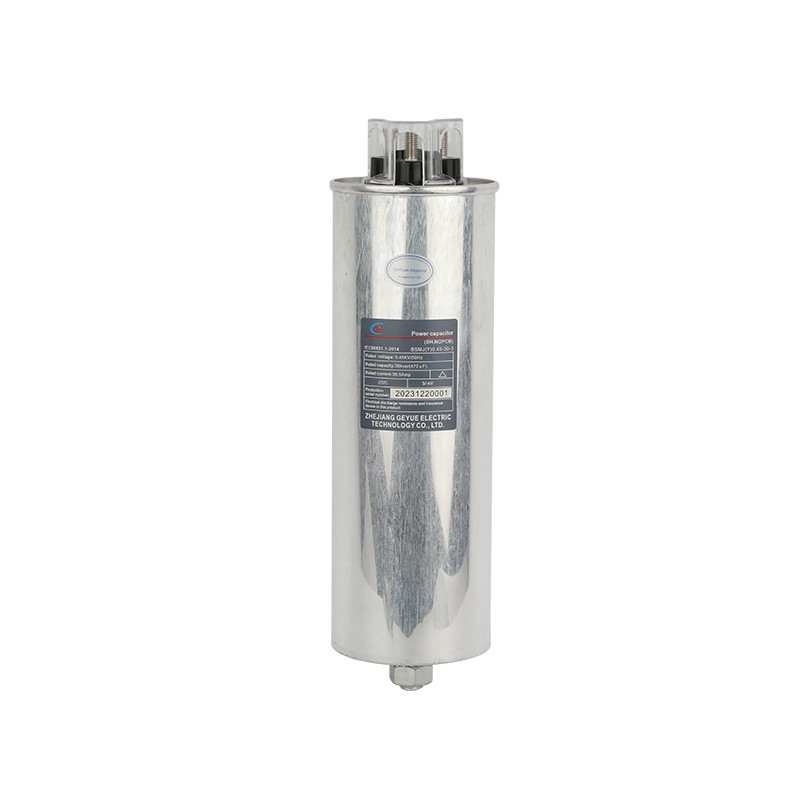
The calculation of the steady-state working current depends on the maximum operating condition of the capacitors during their actual operation. The core formula is: Operating current (A) = Capacitor rated capacity (kvar) / (√3 * Actual operating line voltage (kV)). It is particularly important to note that if the rated voltage of the capacitors is higher than the system operating voltage, the actual output capacity and current of the capacitors will decrease by a square factor. In this situation, the basis for choosing the contactors is the actual working condition of the capacitors in the specific system, rather than the ideal parameters listed on capacitors’ nameplates. That is, for the CJ19 Series Capacitor Switching Contactors, the most suitable current rating should be selected to be smaller and more economical based on the actual working current of the capacitors after reduction.
However, whether the CJ19 Series Capacitor Switching Contactors can successfully and safely perform the task of switching on and switching off the capacitors largely results from whether they can withstand the dynamic surge current in the circuit. The rated working current of CJ19 Series Capacitor Switching Contactors is defined under the condition that they can withstand thousands or even tens of thousands of standard surge current impacts. Therefore, the most effective and accurate method to select the most suitable rated current for the CJ19 series contactors is to refer to the "Capacitor Capacity - Recommended Contactor Model" comparison table provided by the manufacturer. For example, in a low-voltage reactive power compensation system with a rated voltage of 400V, a single capacitor rated capacity of 30kvar, and a steady-state current of approximately 43A per capacitor, considering the surge current in the circuit, we usually recommend that users select CJ19 Series Capacitor Switching Contactors with a rated current of no less than 63A.
Consider the Key On-Site Variables in Practical Applications
While already combining the use of formula and the comparison table, a more thorough consideration of on-site variables will enable you to select the CJ19 Series Capacitor Switching Contactors with a current rating that is closer to the most suitable. The primary variable to consider is the switching strategy adopted by the local reactive power compensation project: is it single-unit switching (meaning each capacitor is independently controlled and switched one by one)? Or is it multi-unit grouped and cyclic switching (meaning multiple capacitors are fixedly grouped into one unit and switched as a whole in a cycle, with each group of multiple capacitors as the minimum unit)? When using the "group switching" strategy, if one group of capacitors (Group A) is first switched on, and the second group of capacitors (Group B) is later switched on, then at the instant of closing the switch, the inrush current generated by Group B comes not only from the grid voltage, but more seriously, from the already charged capacitors in Group A that will instantly discharge to Group B. This will lead to a much larger superimposed inrush current than when switching on a single group. At this time, the specification of the CJ19 Series Capacitor Switching Contactors should be appropriately upgraded, that is, choose contactors with a larger current rating. The second variable to consider is the system harmonic environment: when the background harmonic content is high, the current of the capacitor circuit will increase due to harmonics and may cause resonance amplification. It is recommended to reserve an additional 15%-25% margin based on the calculated operating current value, or preferentially use anti-harmonic smart capacitors. The last variable to consider is the installation method and working environment: the dense installation method and poor ventilation working environment will deteriorate the heat dissipation conditions of the CJ19 Series Capacitor Switching Contactors, affecting their load-carrying capacity. When selecting, it is also necessary to appropriately upgrade the specification, that is, choose contactors with a larger current rating.
The One-Stop Solutions of Geyue Electric
To establish a stable and reliable low-voltage reactive power compensation system, what users need goes far beyond the correct matching of CJ19 Series Capacitor Switching Contactors. What is truly required is the perfect coordination among all components, and this is precisely the core value that Geyue Electric provides for our users.
As a professional manufacturer with a long history in the field of low-voltage reactive power compensation, Geyue Electric not only offers you a full range of high-quality components from CJ19 Series Capacitor Switching Contactors to anti-harmonic capacitors, series reactors, and APFC controllers, but also provides you with an integrated solution based on precise load analysis and system diagnosis. Our technical team will thoroughly consider your distribution structure, load characteristics, and harmonic conditions, and design a complete system from precise selection to optimized wiring for you, ensuring that each circuit is safely matched, so that your compensation device can not only efficiently improve the power factor but also achieve a longer service life and lower overall maintenance costs.
Send Inquiry

Contact Info
-
Address
Zhangwan Industrial Zone, Beibaixiang Town, Yueqing City, Wenzhou City, Zhejiang Province, China
-
Tel
-
Email
COMPANY
Zhejiang Geyue Electric Technology Co., Ltd.
ADDRESS
Zhangwan Industrial Zone, Beibaixiang Town, Yueqing City, Wenzhou City, Zhejiang Province, China
FAQ
Q1-What is the meaning of APFC in electrical system?
APFC is an Automatic Power Factor Control panel which is used to improve the power factor, whenever required, by switching ON and OFF the required capacitor bank units automatically.The components of an Automatic Power Factor Correction (APFC) panel include:power capacitors, capacitor duty contactors, MCBs, APFC relays, APFC controllers, wires, an encloser and protection devices.
Q2-How does APFC panels help?
APFC panels are used to correct power factor and are considered a crucial device in managing power factor requirements. They can help to:
1)Optimize the electricity environment and power consumption
2)Reduce operational cost and energy losses
1)Optimize the electricity environment and power consumption
2)Reduce operational cost and energy losses
Q3-Could you please tell me what are your advantages?
1) Since 2011, we have 13 years of manufacturing experience in the field of power capacitors and power factor correction components (PFC components).
2) We are an OBM manufacturer, we also provide ODM and OEM services at the same time.
3) We produce high-quality products in conformity with the JB/T, GB/T, and IEC standards.
4) We have professional technical experts and one-stop services to support EPC projects and tenders.
4) As a senior foreign trader and sophisticated electrical industry practitioner, we also provide customers with agent procurement services for other electrical products.
2) We are an OBM manufacturer, we also provide ODM and OEM services at the same time.
3) We produce high-quality products in conformity with the JB/T, GB/T, and IEC standards.
4) We have professional technical experts and one-stop services to support EPC projects and tenders.
4) As a senior foreign trader and sophisticated electrical industry practitioner, we also provide customers with agent procurement services for other electrical products.
Q4-In which countries are your products popular?
Our products are very popular in the Asia Pacific, especially in the Southeast Asia, Central Asia, Eastern Europe, Middle East and South America.
Q5-Could you please tell me how long is the lead time?
It depends on the complexity of the order:
1) Within 2 weeks after payment for a standard order
2) Within 1 week after payment for a standard sample order. (The sample is not free)
1) Within 2 weeks after payment for a standard order
2) Within 1 week after payment for a standard sample order. (The sample is not free)
Q6-Could I know the remittance route please?
All the payments must be made before production. The transfer charge shall be borne by the buyer.
1) Standard order could be paid by T/T.
2) Small order payment could be supported by PayPal and Made-in-China Global Pay.
1) Standard order could be paid by T/T.
2) Small order payment could be supported by PayPal and Made-in-China Global Pay.
Q7-Any suggestion for the delivery please?
We normally do EXW, FCA and FOB, (MOSTLY, EXW).
In some special cases, we can also go DDU and DDP.
1) Express delivery, door to door service.
2) By air freight, to the designated airport of the destination country.
3) By sea, FCL , LCL, etc...to the POD.
In some special cases, we can also go DDU and DDP.
1) Express delivery, door to door service.
2) By air freight, to the designated airport of the destination country.
3) By sea, FCL , LCL, etc...to the POD.
Q8-Any support or service after sales please?
1) Standard quality guarantee is 12 months.
2) 24 hours online manual service for assistance and emergency.
2) 24 hours online manual service for assistance and emergency.
Q9-Which certificate do you have for your equipment?
We have ISO and CCC certificates.If the potential client has requirements for other international certificates, we will consider certification according to the client's expected annual purchase volume.
Q10-In case we should visit you, how far is your factory from the airport and how far is your factory from the hotel?
Our factory is located in Beibaixiang Town, Yueqing City, Wenzhou, less than 40 minutes' drive from Wenzhou Longwan Airport. Within three kilometers of our factory, in Beibaixiang Town, we can find you comfortable hotels at all price points.
Q11-If we want to do ODM or OEM services at your company, what should we offer?
If you want to purchase our OEM service, you need to provide the product design drawing, the design authorization and the authorization of your company's brand. In addition, your company needs to sign an OEM contract with us; If you want to purchase our ODM service, you only need to provide the authorization of your brand, in addition, your company also needs to sign an ODM contract with us.
Q12-Will you attend the fair to show your products?
Yes, we absolutely will. Every year, we choose to participate in some international fairs to show our company's strength and products. Last year, we attended ELEKTRO 2024 in Moscow, Russia, where we introduced ourselves to the Russian market. Before each fair, once attendance is confirmed, we will publish our attendance on the official website. So please stay tuned for our plans for 2025.
News Recommendations